If you’ve turned on a TV, opened Facebook or checked your mailbox lately, you already know. It’s election season, and the ads are everywhere.
Here’s the number we could not believe. AdImpact projects that political ad spending for this cycle will hit $11.6 billion. That’s a record. It beats the 2024 presidential cycle ($11.2 billion) and blows past the last midterm record of $8.9 billion in 2022. For a midterm. Where most of us can’t name half the people on the ballot.
We’ve spent our careers in marketing and PR. We love a good campaign. But we also know how the sausage gets made, and right now some of that sausage is made of AI, fake accounts and outright fiction. So let’s talk about it.
Fun Fact: Political Ads Can Legally Lie to You
When a brand like ours runs an ad, we’re held to truth-in-advertising standards. Political candidates? Different rules.
Under federal law, broadcast stations generally can’t censor an ad from a candidate, even if it’s totally untrue. They have to air it as is, and they aren’t liable for what it says. (Ads from PACs and outside groups are a different story, but those get very little real-time scrutiny either.)
Let that sink in. The laundry detergent commercial is held to a higher standard than the person asking to run your state.
And it’s not just the ads. Candidates say inaccurate things on TV all the time, in interviews, speeches and debates. Most of the time, the most a network can do is fact-check after the fact, and by then the clip has already made the rounds on Facebook.
But every once in a while, a network decides enough is enough. On November 5, 2020, ABC, CBS and NBC all cut away from President Trump’s live White House address as he claimed, without evidence, that the election was being stolen from him. MSNBC interrupted him too. NBC’s Lester Holt told viewers plainly, “There has been no evidence of that.”
That’s the difference. A paid ad from a candidate has to run as is. Live news coverage is the network’s own editorial call, so they can pull the plug when a speech turns into an obvious stream of falsehoods. It doesn’t happen often, which is exactly why it made headlines. And not everyone cut away: Fox News and CNN aired the full address, with CNN adding an on-screen caption noting there was no evidence. So depending on which channel you were watching, you got a very different version of that night.
This Isn’t New. It’s Just Faster.
Before we blame it all on the internet, a quick history lesson. Political persuasion has been bending the truth for a long time. What’s changed is speed, scale and how hard it is to tell what’s real.
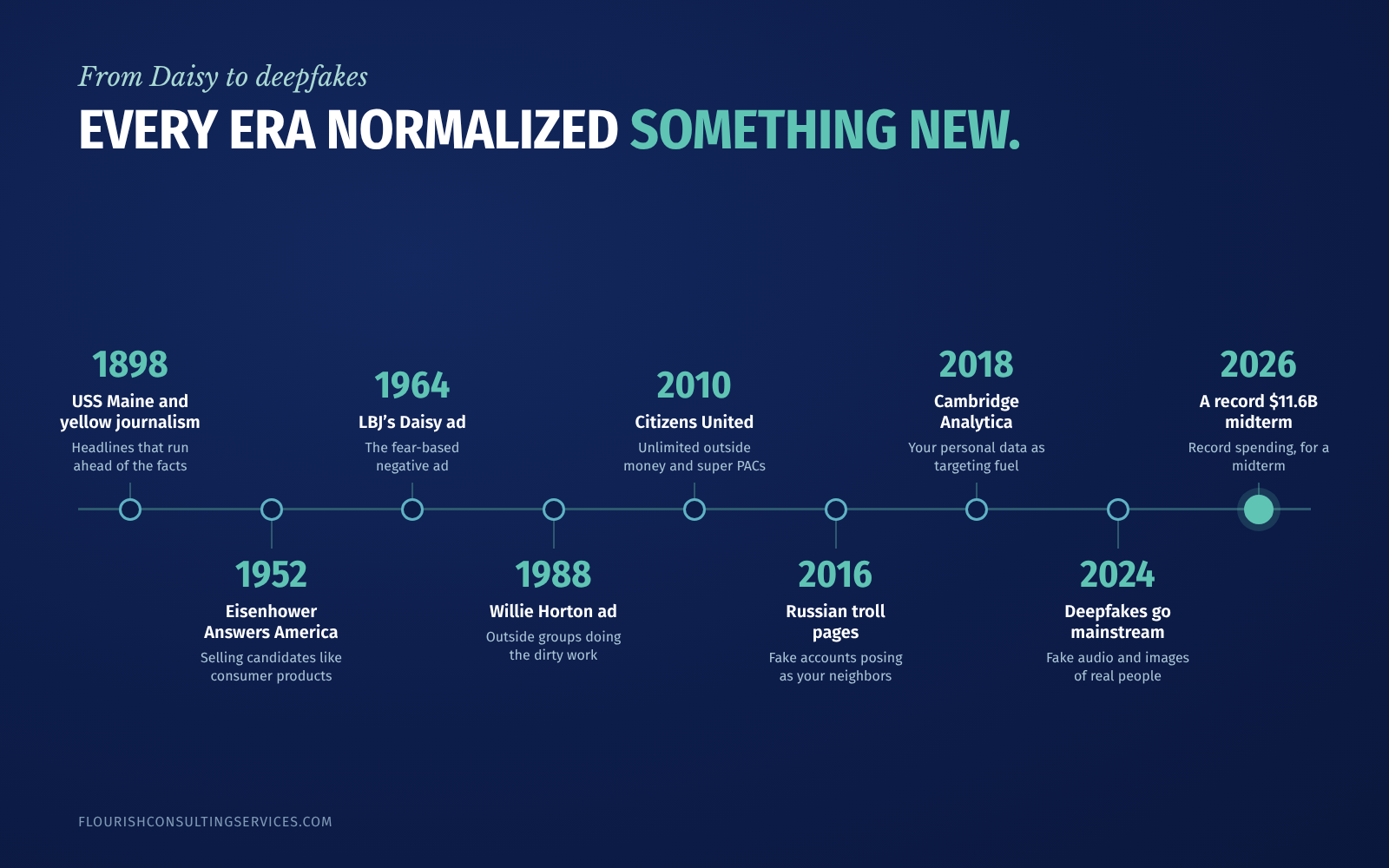
1898: Fake news starts a war (sort of). When the USS Maine exploded in Havana Harbor, killing about 260 sailors, Hearst’s New York Journal and Pulitzer’s World both published a fake “suppressed” cable suggesting the blast was no accident. Later investigations point to a likely accident. By April, the country was at war with Spain, and Hearst’s paper was bragging about “the Journal’s war.” The newspapers didn’t start the war alone, but they poured gasoline on it.
1952: Selling a president like candy. Eisenhower’s campaign hired Rosser Reeves, the ad man behind the M&M’s “melts in your mouth” slogan. Reeves filmed about 40 TV spots in one day and set out to “package and sell” a candidate like a product. His opponent refused to use TV. Ike won. Politics has been a product launch ever since.
1964: The ad that aired once and never went away. LBJ’s “Daisy” ad showed a little girl picking petals before a nuclear blast. It ran as a paid spot exactly once and never even named Barry Goldwater. News outlets replayed it for free, and it helped kick off the era of negative political advertising.
1988: Fear, race and an outside group. The Willie Horton ad was paid for by an independent PAC, not the Bush campaign, and aired only briefly. It was widely condemned as racist. Political scientists still debate whether it changed the outcome, but it became the playbook for fear-based attack ads that let a campaign keep its own hands clean.
2010: The floodgates open. After the Supreme Court’s Citizens United decision, outside spending exploded. By 2015, the Brennan Center found that just 195 individuals and their spouses had given almost 60% of the $1 billion spent by super PACs in federal elections since the ruling.
2016: Your new Facebook friend lives in St. Petersburg. Facebook told Congress that content from Russia’s Internet Research Agency may have reached about 126 million Americans between 2015 and 2017, through more than 80,000 posts from fake pages that looked like regular American groups.
2018: The quiz that wasn’t just a quiz. We learned Cambridge Analytica had data on up to 87 million Facebook users, much of it pulled through a personality quiz app that also scraped users’ friends. Remember all those “Which Golden Girl are you?” quizzes? Yeah.
2024: The deepfake election. Thousands of New Hampshire voters got a robocall with an AI-generated Biden voice telling them not to vote in the primary. It came from a Democratic consultant, who was fined $6 million by the FCC and later acquitted of criminal charges. That August, Donald Trump posted AI-generated images of “Swifties for Trump” with the caption “I accept!” Taylor Swift had endorsed no one. Weeks later, she endorsed Kamala Harris, saying the fake images “really conjured up my fears around AI.” And at the September debate, Trump repeated a viral rumor that immigrants in Springfield, Ohio, were eating pets. City officials said there was no evidence. The rumor started with an unverified screenshot on X.
Notice the pattern? Every era normalized something new. Selling candidates like soap. Going negative. Letting outside groups do the dirty work. Unlimited money. Fake accounts. And now, fake reality. Each one started as shocking and ended up as “just how it’s done.”
Why It’s Hitting Our Parents Hardest
We say this with love, because we have parents too. The people most likely to fall for this stuff are often the ones who grew up trusting what they saw on the evening news and read in the paper – thus the reason you need to call your mom 🙂
The research backs it up. A Princeton and NYU study found that during the 2016 campaign, Facebook users over 65 shared about seven times as many fake news articles as users aged 18 to 29. The good news? Only about 8.5% of users shared any at all.
It isn’t only politics. The FTC reports that older adults’ reported fraud losses jumped from about $600 million in 2020 to $2.4 billion in 2024, and many said scammers found them on social media.
And then there’s Shrimp Jesus. Yes, really. Stanford researchers studied 120 Facebook pages pumping out AI-generated images, from Jesus made of shrimp to fake portraits. Those images pulled in hundreds of millions of interactions, and many commenters didn’t seem to realize they weren’t real. Some of those pages ran scams. Others pushed people toward spammy, low-quality websites. Today it’s a shrimp. Tomorrow it’s a candidate “saying” something they never said.
How to Be a Sharper Consumer (and Help Your Family Do the Same)
None of this means you should stop caring or stop voting. It means we all need to get a little more skeptical. Here’s what we do.
- Check who paid for it. Political ads have to say who paid for them. If it’s a group you’ve never heard of, look them up. A friendly name doesn’t mean a friendly agenda.
- Look it up in the ad library. Meta’s Ad Library lets you see political ads, who’s running them and roughly how much they’re spending.
- Check the account, not just the post. New account? Few real friends? A name like “Patriot Mom 48219”? Thousands of posts a day? That’s not your neighbor.
- If it makes you furious, pause. Outrage is the business model. The angrier a post makes you, the more likely it was built to be shared without thinking.
- Zoom in on photos. Look at hands, text, ears and backgrounds. AI still gets weird there. A reverse image search can show you where a photo really came from.
- Go to the source. If a candidate supposedly said something wild, find the full video or the original article, not the clip of a clip.
- Call your mom. Have the conversation without making anyone feel dumb. Share what you’ve learned. Offer to help them tidy up their feeds. It’s a lot nicer than finding out she sent her savings to a “celebrity” who slid into her DMs.
Our Personal Take
We’re not anti-advertising. Obviously. Advertising is how great businesses get found and how good ideas spread. But persuasion only works long term when it’s built on trust. Brands that lie get caught. The problem is that in politics, there’s often no one to catch them, and billions of dollars riding on the hope that you won’t check.
And the misinformation doesn’t stop at who to vote for. It’s also aimed at whether, and how, you can vote at all.
Heading into this midterm, President Trump has called mail-in voting a “Nation Destroying SCAM” on Truth Social, even though he routinely votes by mail himself and, in an October video, told people to vote by mail too. Claims that mail voting is more prone to fraud aren’t supported by evidence, and noncitizen voting is exceedingly rare. The administration also pushed new Postal Service restrictions on mail ballots, but in September the Supreme Court kept those rules on hold for 2026, so mail voting should work largely as it has in past elections.
The messaging is landing, too. A Pew poll found that only 64% of Democrats now believe mail ballots will be counted accurately, down from 85% in 2024, and fewer Democratic voters plan to vote by mail than in 2022. We can’t help but notice that the loudest “your vote won’t count” messages are coming from the party with the most to lose this November. Whatever the intent, the effect is the same: people who are told their vote won’t count are less likely to cast one.
So here are the truths worth sharing with your family:
- Elections are run by your state and county. Not by a social media post, and not by the White House. Your local election office is the best source.
- If your state offers mail voting, it’s still on for 2026.
- Check your registration, polling place and ID rules at vote.gov or your state’s election site. In Alabama, that’s the Secretary of State.
- If something you hear about voting sounds off, call your county election office. They’d much rather answer the question than have you stay home.
So check. Ask questions. Be the person in your family group chat who says, “Wait, where did this come from?”
And if you’re a business that wants to build a brand people actually trust, with no shrimp required, we’d love to talk.
Sources
- AdImpact forecast: 2026 cycle to hit $11.6bn, Advanced Television, June 12, 2026
- AdImpact’s original 2025-2026 projection ($10.8B), AdImpact, Sept. 2, 2025
- No censorship of candidate ads, Broadcast Law Blog
- Yellow journalism and the Spanish-American War, National Geographic
- Origins of presidential campaign TV commercials, Wisconsin Historical Society
- The Daisy ad, History.com
- The Willie Horton ad, History.com
- Outside spending and dark money post-Citizens United, Brennan Center, Jan. 14, 2015
- Facebook estimates 126 million saw Russia-linked content, WPTV/Scripps, 2017
- Cambridge Analytica data on up to 87M users, TechCrunch, April 4, 2018
- FCC proposes $6M fine over Biden deepfake robocall, NPR, May 23, 2024
- Jury acquits consultant behind Biden AI robocalls, WCAX/AP, June 2025
- Trump posts AI fakes implying Taylor Swift endorsement, Al Jazeera, Aug. 20, 2024
- Citing AI concerns, Taylor Swift endorses Harris, PetaPixel, Sept. 11, 2024
- Springfield officials say pet-eating claims are false, KTVU, Sept. 2024
- Older users shared more fake news in 2016, NBC/AP, on Guess, Nagler and Tucker, Science Advances, Jan. 2019
- FTC annual report on protecting older adults, FTC, Dec. 2025
- How spammers and scammers use AI images on Facebook, Stanford Internet Observatory, March 18, 2024
- Meta Ad Library, Meta
- Networks cut away from Trump’s White House address, AP via ClickOnDetroit, Nov. 6, 2020
- Trump’s fraud claims are impacting voters’ confidence, poll finds, Forbes, Oct. 20, 2026 (Pew poll data)
- Supreme Court blocks Trump’s mail ballot restrictions for 2026, Votebeat, Sept. 15, 2026